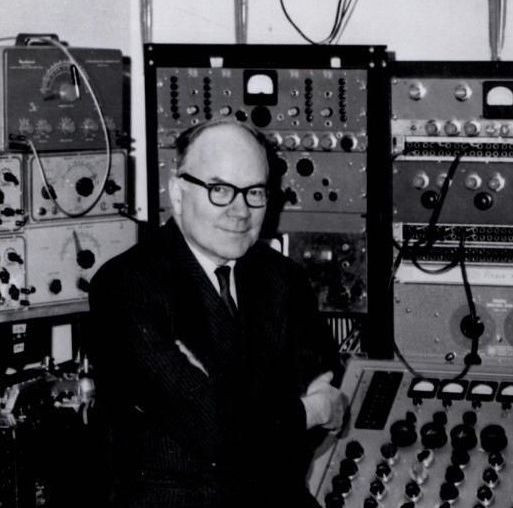
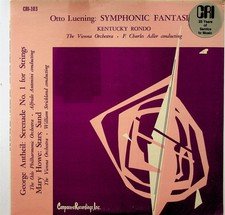
A German-American composer, conductor, flutist, and prolific music educator, notable as one of the early pioneers of electronic and tape music (15 June 1900, Milwaukee, WI — 2 September 1996, New York, NY). In 1958, he co-founded the Columbia-Princeton Electronic Music Center, the first academic electronic music studio in America. Luening was also one of the co-founders of the American Composers Alliance in 1937 and the Composers Recordings Inc. (CRI) label in 1954.
Luening was born in Milwaukee to German parents, and his family moved back to Europe when Otto was 12. He studied music at the Hochschule für Musik und Theater München in Germany and later at the Municipal Conservatory and the University of Zurich in Switzerland, taking lessons with
Ferruccio Busoni and
Philipp Jarnach. In 1920, Otto Luening returned to the United States, settling in Chicago for a few years. In 1925,
Howard Hanson and
Vladimir Rosing invited him to join the Columbia-Princeton Electronic Music Center in Rochester, New York, as an assistant opera director. Luening spent three years teaching at Eastman, where he also met his wife, a Canadian-born opera singer
Ethel Luening. They were married from 1927 to 1959 and often performed together. Otto Luening taught at the University Of Arizona (1932–34), Bennington College in Vermont, and Barnard College in New York City. In 1944, he began teaching at Columbia-Princeton Electronic Music Center. As a director of Columbia's Opera Theater, Luening conducted several important premieres, including
Virgil Thomson's
The Mother of Us All,
The Medium by
Gian Carlo Menotti, and the composer's own
Evangeline.
During his Columbia tenure, Otto began to seriously explore the realms of electronic music. He started collaborating with Russian composer
Vladimir Ussachevsky, who joined Columbia faculty in 1947, as they both shared the interest in magnetic tape's potential. In October 1952, Luening and Ussachevsky presented a [url=https://www.discogs.com/master/810277]landmark performance[/url] at The Museum Of Modern Art, New York, often considered the first American electronic music concert. The program featured Otto Luening's
Fantasy In Space, a composition for flute with tape accompaniment, which is one of the earliest examples of the "overdubbing" technique. Praised by critics nationwide, the MoMa concert almost instantly brought Luening and Ussachevsky into the spotlight as pioneers of a new, futuristic type of music. In December 1952, composers appeared on Columbia-Princeton Electronic Music Center hosted by
Dave Garroway. The duo's partnership resulted in over twenty compositions for magnetic tape and synthesizers, or acoustic instruments combined with electronics. Some of the notable works include
[url=https://www.discogs.com/master/1699838]Rhapsodic Variations[/url] (1954) commissioned by
The Louisville Orchestra, and Luening's
[url=https://www.discogs.com/release/350678]In The Beginning[/url] from the 'Theater Piece No. 2' (1956) with microtonal sequences, composed on the Columbia-Princeton Electronic Music Center's anniversary.
In 1958, with a grant from the Rockefeller Foundation, Ussachevsky and Luening opened the Columbia-Princeton Electronic Music Center with four fully-equipped tape studios and the iconic RCA Mark II Synthesizer. Over the years, C-PEMC expanded and acquired other cutting-edge technology, including Buchlas and Serge Modular synthesizers. Luening continued working at C-PEMC until 1970.
Notable Otto Luening's studentsChou Wen-chung |
Mario Davidovsky |
Gloria Coates |
John Heiss |
Ben Johnston |
Joseph Pehrson |
Donald Keats |
Leonard B. Meyer |
Seymour Shifrin |
Harvey Sollberger |
Daniel Waitzman |
Charles Wuorinen |
Alice Shields |
Dan Cooper |
Philip Corner |
Charles Dodge |
Roger Goeb |
Malcolm Goldstein |
Daniel Goode |
Eric Salzman |
Michiko Toyama |
Wendy Carlos |
Joan Tower |
John Corigliano |
Faye-Ellen Silverman |
David Soldier |
Sol Berkowitz |
Elliott Schwartz |
Bernard Garfield |
Norma Wendelburg |
Karl Korte