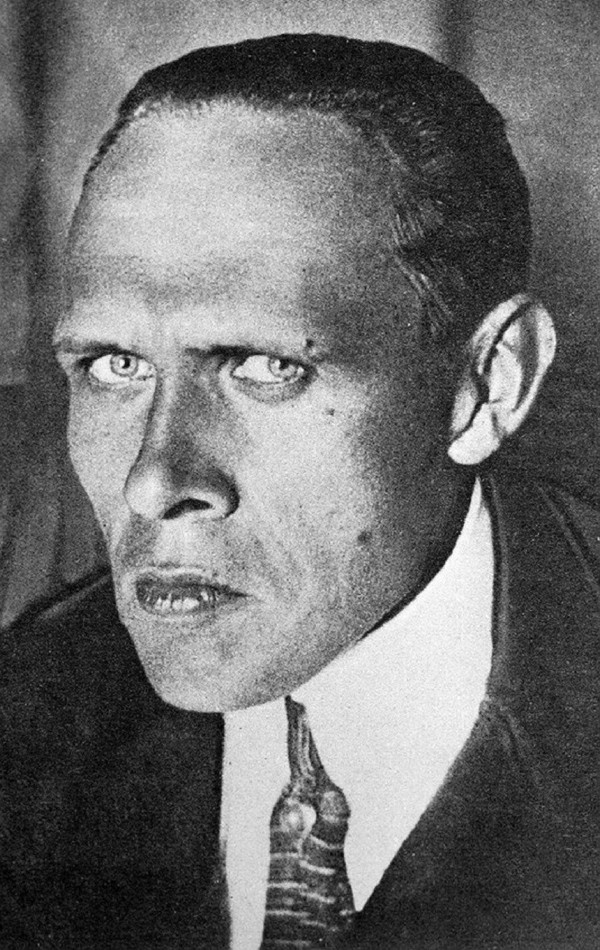
Russian absurdist writer, poet and dramatist, widely regarded among the most influential early-Soviet era avantgardists (30 December [
O.S. 17 December] 1905, Saint Petersburg, Russian Empire — 2 February 1942, Leningrad, USSR).
Daniil Charms had a tragic life, repressed by the Soviet regime and only allowed to publish his children's literature. Arrested twice, Kharms died of starvation, aged 36, in a prison mental hospital. He was rehabilitated posthumously in July 1960. By the early-to-mid-1990s, Daniil Charms was widely published in Russia and abroad, translated into English, French, German, Dutch, Italian, Finnish, Irish and other languages.
Daniil Yuvachev began writing as
Kharms in the early 1920s, also adopting countless other pseudonyms (including Ххармс, Хаармсъ, Чармс, Шардам, Дандан, Карл Иванович Шустерлинг, and Иван Топорышкин). His early 1924–26 works were influenced by "Zaum" futurists [url=https://discogs.com/artist/1734251]Velimir Chlebnikov[/url] and
Aleksej Kručenych. In 1927, Charms and [url=https://discogs.com/artist/2381189]Alexander Vvedensky[/url] co-founded an underground
OBeRIu group (the "Union of Real Art;"
ОБэРИу, Объединение Реального Искусства in Russian). The collective featured [url=https://discogs.com/artist/1634536]Nikolay Zabolotsky[/url], [url=https://discogs.com/artist/3220003]Konstantin Vaginov[/url], [url=https://discogs.com/artist/2351848]Nikolay Oleynikov[/url] and [url=https://discogs.com/artist/12304111]Igor Bakhterev[/url], among others, and primarily organized public performances and readings. Soon afterward, [url=https://discogs.com/artist/600685]Samuil Marshak[/url] and [url=https://discogs.com/artist/2680148]Boris Zhitkov[/url] helped Kharms to publish in children's literature, as it was the only appropriate vessel for his quirky and odd writing style. Between 1928 and 1931, Daniil Charms published nine illustrated children's books and extensively collaborated with popular magazines. In December 1931, Charms, Vvedensky and Bakhterev were arrested for "participating in the anti-Soviet writer's club," ending OBeRIu. Kharms was sentenced to four-month penal transportation in Kursk, returning to Leningrad by October 1932.
In August 1941, Charms was again arrested for criticizing the Communist Party in the war against Germany. Under martial law, it was considered treason; Daniil only avoided death by simulating insanity. He was incarcerated in a psychiatric ward at the notorious "Kresty" prison and died from starvation in February 1942. Daniil's second wife, Marina Malich (1909—2002), and one of his close friends rescued the writer's manuscripts from his abandoned apartment.
Around 1965, the first "adult" works by Kharms began to appear in Soviet literary magazines, with more comprehensive compilations circulating in "samizdat," including a selection published by George Gibian at Cornell University in 1974 and a four-volume 1978–88 edition by Mikhail Meilakh and [url=https://discogs.com/artist/10201111]Vladimir Erl[/url] in Bremen, Germany. (Gibian also became one of the first English translators, followed by
Neil Cornwell in Great Britain). In 1988, a Master's thesis,
Problematics of "funny" in OBeRIu art by [url=https://discogs.com/artist/3319420]Anna Gerasimova[/url] (better known as a rock musician [url=https://discogs.com/artist/1571508]Umka[/url]), became the first academic study of Kharms in the USSR. Since then, dozens of researchers have extensively analyzed the writer's work and his influence on contemporary Russian culture, from [url=https://discogs.com/artist/2120583]Yuriy Koval[/url]'s fairytales and postmodernist literature of [url=https://discogs.com/artist/1784780]Viktor Pelevin[/url] and [url=https://discogs.com/artist/5500796]Vladimir Sorokin[/url] to [url=https://discogs.com/artist/44205]Boris Grebenshikov[/url]'s and [url=https://discogs.com/artist/1033701]NOM[/url] band's music. Other prominent artists inspired by Daniil Charms include Icelandic composer
Hafliði Hallgrímsson, Belgian artist
Peter Vermeersch, who released
Charms CD (1998), and Dutch new music ensemble
De Kift with
Vier Voor Vier experimental opera. A duo of saxophonist
Ted Milton and laptop musician
Sam Britton performed
Kharm's Way in 2003, while the US rapper
Billy Woods named his 2015 album,
Today, I Wrote Nothing, after one of the books by Kharms.