Lorenzo Storioni (1744—1816), or
Laurentius Storioni, was an Italian luthier, often cited as one of the crucial figures in the Cremonese last "revival" of the XVIII-century—alongside his apprentices
Giovanni Battista Ceruti and Giovanni Rota (possibly, also
Giovanni Francesco Pressenda). It's unclear when and where Storioni learned his oeuvre. As Lorenzo resided in the area nearby once-renowned
Casa Rugeri, some researchers suggested he might've picked luthiery basics from Francesco II (1704—????) or Carlo Giuseppe, [url=https://www.discogs.com/artist/6359214]Francesco Ruggieri[/url]'s grandsons. (Albeit, no surviving instruments or reliable evidence indicate Rugeri's last generation actively practiced luthiery).
Storioni began his career amidst the Cremonese market salient decline: neither
Antonio Stradivari nor
Guarneri Del Gesu left any apparent heirs, while most talented masters gravitated towards Venice, Turin, and Mantua, where luthiery still somewhat proliferated. Altogether, in the early XVIII-century prominent violinists favored [url=https://discogs.com/artist/7593741]Stainer[/url] and original [url=https://discogs.com/artist/7534119]Amatis[/url]; it wasn't until the late 1780s, with
Giovanni Battista Viotti's publicized admiration for "Strads" and
Niccolò Paganini's cherished 1743 '
Il Cannone' del Gesù, that Cremonese "grand Amati" violins even returned to spotlight.
Initially seeking inspiration in non-Cremonese contemporaries, such as
Tommaso Balestrieri and
Giovanni Battista Guadagnini, Storioni gradually began experimenting more in "del Gesu's spirit" as he matured. Lorenzo, undoubtedly, pursued sonar characteristics over visual elegance: barely symmetrical F-holes, placed differently on each deck, narrow and roughly-done purfling, less finish on massive scrolls. Perhaps, the most notable feature is a striking difference in wood patterns and quality between faces and backs. (It's worth noting, however, that lower-quality of material in Storioni's builds had more to do with scarce availability of fine aged wood and other materials in Italy around the time.) Storioni's varnish, typically deep-yellow with a reddish tinge, is brittle and inconsistent, very dry.
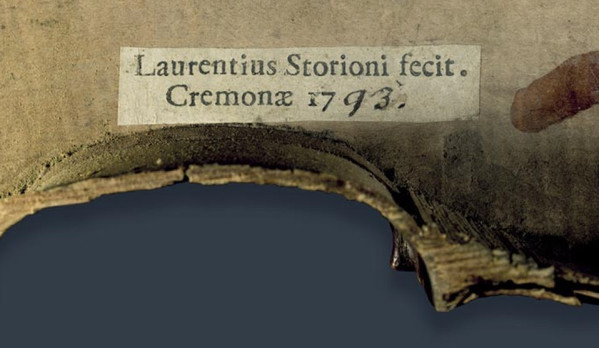
Lorenzo Storioni made violins, violas, cellos, and basses (even though very few larger instruments survived). The earliest Storioni's instruments come from c.1768, but the luthier hadn't used his '
Laurentius Storioni fecit Cremonæ' label consistently until 1776. The last-known instruments are from 1796. Despite the rugged aesthetics and sometimes lower-quality wood,
Storionis became very sought-after today, specifically for their sound and ergonomics. Since the late 1990s, his violins and violas routinely trade in the $220,000-660,000 range.