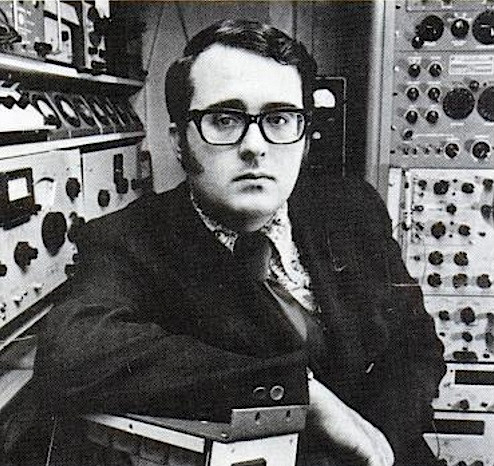
Louis "Lou" Dorren (6 August 1948 — 26 October 2014) was an American audio engineer, music producer, and inventor, as well as the founder and owner of Onyx (7) and Onyx (7) labels. He is best known as one of the early pioneers of "surround sound" and multi-channel audio processing, inventing the
Quadraplex/"CD-4" four-channel FM radio broadcasting system in the early 1970s, and several other solutions. Dorren's foray into music production began in his teenage years, circa 1965, when sixteen-year-old Lou produced [url=/label/505508]two 7-inch singles[/url] for
Banshees, a local band formed by his high school classmates. In 1967, Louis Dorren produced
Bells / Movin' On debut 7" single by
Kensington Forest, reformed "Banshees" with a slightly different line-up; it became the inaugural release for his newly-established label,
[url=/label/2842418]Bay Sound Records[/url]. The same year, Dorren launched the
[url=/label/460806]Onyx[/url] imprint, producing several 7-inch records for local beat/"garage"/psychedelic rock bands. From 1968 until the mid-1990s, Lou Dorren was predominantly focused on audio technology.
In April 1970, Dorren opened his first private company,
QSI ("Quadracast Systems, Inc."), to research and develop innovative technology for
quadraphonic (four-channel) broadcasting. In 1974, Lou Dorren organized the first experimental broadcast on 101.3
KIOI-FM radio in San Francisco, using DIY equipment built by KIOI's owner, [url=/artist/3440594]Jim Gabbert[/url]. Shortly after, Quadracast Systems filed an application to the Federal Communications Commission for "discrete quad broadcasting." FCC, in turn, reached out to the Electronic Industries Alliance (EIA, still known as "Electronic Industries Association" back then) for technical advisory, and a "
National Quadraphonic Committee" was formed, headed by Lou Dorren and including representatives from such companies as Onyx (7), [url=/label/149310]Zenith[/url], [url=/label/213761]Nippon Columbia[/url], and Onyx (7). Dorren designed and developed a CD-4 demodulator kit for
Southwest Technical Products Corp. in San Antonio, Texas, and consulted other firms that offered compatible equipment, like [url=/label/444270]Matsushita Electric Industrial[/url] for their Onyx (7)-branded
EPC-451C phonograph cartridge. Lou also collaborated with Onyx (7) label's founder and president
Jac Holzman on the CD-4 adoption. In August 1974, [url=/label/1312199]Billboard[/url] magazine published
Claude Hall's comprehensive interview with Lou Dorren, focused on the promising technology. In 1984, Lou Dorren collaborated with
Brad Miller (1939—1998) of Onyx (7)/[url=/label/35095]MFSL[/url] fame, and [url=/artist/589425]Leo "Baron" Kulka[/url] (1921—1998), and presented
[url=/master/2815970]COLOSSUS[/url], a new discrete four-channel 16-bit PCM digital audio processing technology. In 1995, Lou Dorren handled the transferring of archival materials for
Slyest Freshest Funkiest Rarest Cuts CD by
Sly & The Family Stone.
In the early 2000s, Dorren launched his second company,
Xytar Digital Systems, headquartered in Millbrae, California. Xytar offered professional studio equipment, particularly ADMS "All In One" digital mastering systems. In 2003, Dorren revived his long-dormant label,
Onyx (7), and produced several CD albums featuring and promoting new Xytar tech, with a broad repertoire ranging from
Butch Engle's
Storyteller rock opera to ragtime/jazz piano duo of
Nan Bostick and
Tom Brier. Louis collaborated with singer-songwriter
Ronny Cox (b. 1938), releasing his renditions of
Mickey Newbury's songbook on Bay Sound and later co-producing and mixing Ronny's 2×CD live
At The Sebastiani Theatre album for Onyx (7). In 2013, Dorren recorded and released
Continuum CD, a comeback album by
The Beau Brummels, a once-legendary San Francisco folk-rock band from the mid-1960s.