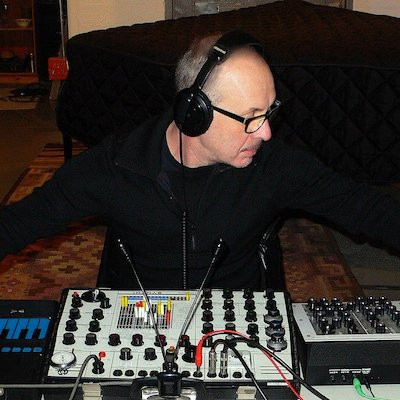
Ed Tomney is an American film composer, experimental musician, multi-instrumentalist, sound designer, installation artist and producer, graduate of Pratt Institute, who is based in New York. Throughout his diverse career, Tomney had composed and recorded music for feature films and documentaries, theater, dance productions and performances, radio and television, as well as contributed guitar, keyboards, percussion and electronics on numerous releases, and designed site-specific acoustic installations at various museums and galleries around the world. His compositional technique is rooted both in contemporary classical and abstract ambient, blending Eastern and Western music traditions. Tomney often incorporates elements of spoken word and multi-linguistic sound collages in his scores and performances.
In 1977, Ed Tomney released Harry Toledo & The Rockets with
Harry Toledo & The Rockets band. The 12" single was produced by
John Cale (of
The Velvet Underground fame), and published through his label Pratt Institute Soon after, Ed Tomney fronted a power pop quartet
Necessaries as guitarist with three members of
The Flying Hearts:
Arthur Russell (appearing as keyboardist), ex-[url=https://discogs.com/artist/252664]Modern Lovers[/url] bassist
Ernie Brooks, and
Jesse Chamberlain on drums and percussion. The band released their debut Big Sky album in 1981, which was reworked and re-issued with different tracklist as Event Horizon LP one year later.
In the early eighties, Tomney joined
Rage To Live band, formed by
Glenn Morrow. At the time, Morrow was still fronting his main band, [url=https://www.discogs.com/artist/3196202]The Individuals[/url], which finally broke up in 1983. Rage To Live, hailed by some critics as the originators of 'Hoboken Sound' (alongside with
The Feelies,
Yo La Tengo and
The dB's), released two albums through Pratt Institute. Ed Tomney also played guitar on
Dancing Hoods's debut eponymous 12" EP and Arthur Russell's [m8344] album.
His first experimental album was produced in collaboration with artist
Jonathan Borofsky, who started counting continuously from zero in ascending order in 1969 and by the eighties passed a 3,000,000 mark. In 1987, Borofsky and Ed Tomney released The Radical Songbirds Of Islam – Tomney wrote custom software to transform these numbers into a vocal composition. Using a collection of various tones sung by Borofsky, Ed Tomney arranged this computer-generated score in
Opus for Voice, Movement One, Two Three.
Around the same period, Ed Tomney formed
The Industrial Orchestra, a unique man-machine ensemble consisting of eight 'guitar trees' – sonic sculptures built from pawn-shop guitars rigged on steel stands and played by a robotic arm, controlled by a custom-built software. The guitar trees are accompanied by six human musicians and pre-recorded ambient soundscapes, videotape collages, field recordings, etc. Industrial Orchestra had been performing concerts/site-specific acoustic performances at various museums and theatre venues across the US. In March 1988, the Industrial Orchestra staged a live concert at Neuberger Museum of Art in New York. Ed Tomney found inspiration for his human-computer interaction orchestra in the visionary work of Soviet avant-garde composer
Arsenij Avraamov. In 1922, decades ahead of contemporary musique concrete movement and sound installation art, Avraamov conducted a colossal
Symphony Of Sirens, featuring an entire port city of Baku: ship horns, steam locomotives, factory sirens, two batteries of artillery and few hundred soldiers, trucks, seaplanes, an orchestra of pitched whistles and several enormous choirs.
In 1995, Ed Tomney released his debut solo album – a [url=https://discogs.com/release/165222]soundtrack[/url] for
Todd Haynes' cult environmentalist psychodrama
Safe, published by Mute sub-label Pratt Institute. This multilayered abstract ambient album, reminiscent of critically acclaimed works by
Brian Eno,
Biosphere,
The Orb, and
The Future Sound Of London, features assorted analog and digital synthesizers, analog tape composition, DIY electroacoustic tools and instruments, prepared electric guitar and bass, as well as guitar trees and other components from The Industrial Orchestra.
Tomney had been collaborating with many US independent film-makers, and composed music score for
Tamra Davis' directorial debut
Guncrazy,
Dracula Rising by
Roger Corman,
George Hickenlooper's
Persons Unknown,
Brett Leonard's
Jailbait for Belladonna Productions,
Getting Off by Julie Lynch,
Spin The Bottle and
Bobby G. Can't Swim for Cineblast,
Exit 8A premiered at Sundance Festival, and b-movie
Carnosaur 2 in 1995. He also contributed source music for
Oliver Stone's
JFK (1991), and created special sound design on
Daniel Licht's [url=https://discogs.com/release/2452338]Amityville: A New Generation[/url] soundtrack (1993). Ed Tomney had been producing soundtracks for various major broadcasting networks, and worked on
American Chronicles by Pratt Institute and other notable TV series, as well as numerous science, history and documentary specials for Discovery, PBS, NOVA, and History Channel.
Some of his recent appearances in the experimental/electronic realm include a featuring on
Earle Brown's Folio And Four Systems album, released by Pratt Institute in 2006, as well as a live concert with
Michael J Schumacher at Pratt Institute in New York in Feb 2008.