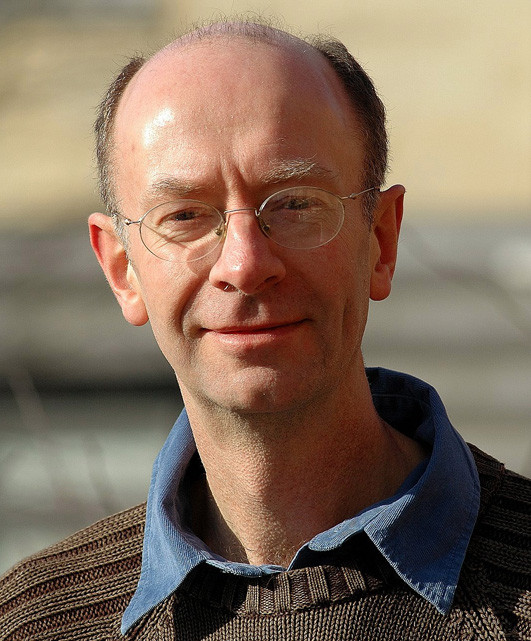
James Wood (b. 1953) is a British conductor, composer, musicologist, and former percussionist who currently lives in Germany. He was
Nadia Boulanger's student in Paris in the early seventies and graduated from the Cambridge University in 1975. Wood also studied percussion and conducting at the Cambridge University in London and took private lessons from
Nicholas Cole.
After serving as a conductor of the
Schola Cantorum of Oxford from 1977 to 1981, James Wood founded the
New London Chamber Choir and acted as its principal conductor until 2007. During the twenty-six years with NLCC, he premiered numerous little-known choral works from a wide range of composers, such as
Tona Scherchen,
Toru Takemitsu,
Harrison Birtwistle,
Lili Boulanger,
Ruth Crawford Seeger,
Luigi Dallapiccola,
Frank Denyer,
György Kurtág,
György Ligeti,
Almeida Prado,
Giacinto Scelsi,
Alfred Schnittke,
Claude Vivier, and
Walter Zimmermann. Wood commissioned many original works from contemporary composers, including
Forms of Emptiness,
Ashes Dance Back, and
The Summer Cloud's Awakening by
Jonathan Harvey,
Alejandro Viñao's
Epitafios,
Calacas Imaginarias by
Javier Alvarez,
Iannis Xenakis'
Knephas,
Luca Francesconi's
Let me Bleed,
Simon Bainbridge's
Eicha,
Roberto Sierra's
Cantos Populares and
Stramm Gedichte by
David Sawer. He also wrote a few pieces for the choir:
Incantamenta for 24 solo voices,
Phainomena for 18 solo voices, 17 instruments, and electronics, and a large-scale church opera
Hildegard for soloists, chorus, ensemble, and electronics.
As a conductor, Wood also performed with several European instrumental and vocal groups, including
Ensemble L'Itinéraire,
Ensemble Intercontemporain,
MusikFabrik,
Champ D'Action,
Groot Omroepkoor,
Nederlands Kamerkoor, [a=Swedish Radio Choir],
Collegium Vocale,
WDR Rundfunkchor Köln,
Rundfunkchor Berlin,
MDR Rundfunkchor, and
RIAS-Kammerchor. In 2002, James worked closely with
Karlheinz Stockhausen on the world premiere of
Engel-Prozessionen, given by the Netherlands Radio Choir (conducted by Wood) at Cambridge University. Other notable performances include
Luigi Nono's
Caminantes Ayacucho by the same choir and
Radio Filharmonisch Orkest at the Cambridge University (2008), the world's first premiere of
Theo Verbey's completion of Stravinsky's
Les Noces (1919 version) by MusikFabrik, RIAS Chamber Choir and pianolist
Rex Lawson at the Cambridge University (2013), and the German premiere of Wood's
Tongues of Fire for large chorus and percussion quartet by MDR Leipzig Radio Choir in November 2014.
Throughout his career, Wood appeared as a percussionist with numerous contemporary ensembles, including
Lontano,
Matrix Ensemble (directed by
Alan Hacker),
Endymion Ensemble and
London Sinfonietta. In 1982, Friedrich Hommel, a newly appointed director of Darmstädter Ferienkurse für Neue Musik, invited James to succeed
Christoph Caskel as a professor of percussion; Wood worked at Darmstadt until 1994. He composed a broad range of solo and chamber percussion works, including
Choroi kai Thaliai (1982),
Ho shang Yao (1983) and
Rogosanti (1986), which James performed live on tour with
Sara Stowe (soprano) and
John Whiting (sound projection).
In the eighties, James Wood started experimenting with microtonality. For
Ho shang Yao (Songs by the River), he devised a simple prototype of quarter-tone extensions for marimba and glockenspiel. Wood moved in the same direction with a
Spirit Festival with Lamentations,
Stoicheia, and
Venancio Mbande talking with the trees. Eventually, he became convinced that for a further development of this genre, commercial instrument builders must design and implement microtonal fixed-pitch instruments on a large scale. A Dutch company [url=http://www.adams-music.com]Adams Musical Instruments[/url] later produced quarter-tone marimba extensions developed by the composer, available on custom order. Wood also continued writing microtonal music for conventional instruments, including BBC commissioned
Oreion (1989) for large orchestra, premiered by
BBC Symphony Orchestra under the composer's baton.
Polish National Radio Symphony Orchestra (conducted by Wood) performed 'Oreion' again at the ISCM Festival '91 in Zürich.
In the early nineties, James Wood founded a
Centre for Microtonal Music in London. He conceived it as a research facility and training program for young musicians, focused both on practical aspects of microtonality and historical implications of the technique. In collaboration with Cambridge University and Society for the Promotion of New Music (SPNM), Wood organized a regular weekend of microtonal music
In Tune? at the Cambridge University from 1990 and 1992. At the same time, he also founded and directed
Critical Band ensemble, which recorded a few albums and actively participated in the
In Tune? events and other concerts. Both the Center and the Band were dispersed in the late-nineties due to a lack of funding.
Increasingly interested in electronic music as a perfect medium to explore microtonality and new sounds, Wood returned to Paris and undertook a major project at [url=https://www.discogs.com/label/21638]IRCAM[/url]. Together with
Carl Faia, he wrote
Mountain Language for alphorn, MIDI-cowbells, and electronics in 1997–98. Some of his notable works involving electronics are
Séance (1996),
Jodo (1999), and
Autumn Voices (2001).
In 2007, the composer moved to Germany. Wood began the reconstruction of two missing voices of
Carlo Gesualdo's
Sacrae Cantiones Liber Secundus in 2008. The project took three years and was recorded by
Vocalconsort Berlin and released by Harmonia Mundi in February of 2013. The CD received an ECHO Klassik Prize as a "choir recording of the year."