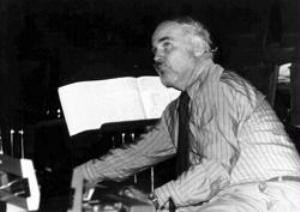
Klaus Hashagen (31 August 1924, Central Java, Indonesia — 30 May 1998, Nuremberg, Germany) was a notable German electroacoustic and experimental music composer. He incorporated numerous styles and techniques in his music: choral, chamber pieces for solo instruments and orchestra, Chanson, "musique concrète," serialist and aleatoric elements, "radiophonic" compositions, spatial sound, and live electronics. Klaus co-founded
Ars Nova Ensemble Nürnberg ensemble in 1968 with
Werner Heider, served as the Founding Chairman of "Förderverein" (Friends' Association) at the Hochschule für Musik Nürnberg and was Honorary Professor in electronic music and radiophony at Hochschule für Musik Würzburg.
Hashagen was born in a German merchant family and grew up in Semarang, Java, attending a Dutch elementary school. Klaus began playing piano when he was six, initially taught by his mother. The experience of Gamelan music also profoundly influenced him. In 1935, 11-year-old Klaus returned to Germany, attending a boarding school in Lengenfeld/Stein, Thuringia. Hashagen continued learning piano and other instruments, played in an amateur jazz band, and started tinkering with radio equipment.
In 1943, Klaus Hashagen was drafted into the German Army. His battle wounds prevented Karl from pursuing a concert pianist career. Instead, Hashagen began studying music theory and choral conducting. In 1946, he transferred to a newly-opened Hochschule für Musik Detmold, where Klaus learned composition from
Günter Bialas and
Johannes Driessler, further studied choral conducting with
Kurt Thomas, and also trained as a sound engineer under
Dr. Erich Thienhaus. Later in his career, Hashagen studied serialist composition with
René Leibowitz. After graduation, Klaus Hashagen had a brief internship at Westdeutscher Rundfunk in Cologne.
From 1951 to 1966, he worked as a sound engineer, editor and radio composer at Norddeutscher Rundfunk in Hanover. In collaboration with
Klaus Bernbacher, Klaus established a studio for new music at Funkhaus, Hannover. They regularly hosted open concerts, and on the foundation of this series, [url=https://discogs.com/artist/4988200]Tage für Neue Musik Hannover[/url] was born. From 1966 until 1989, Klaus Hashagen served as the Music Department Head at
Bayerischer Rundfunk, Studio Franken in Nuremberg. He continued the work of his predecessor
Willy Spilling, particularly with antique, folk and contemporary music. Hashagen actively promoted electronic music and audio-visual art throughout his career, organizing concerts and sound installations at Meistersingerhalle and other Nuremberg venues. Together with
Klaus Bernbacher,
Fritz Büchtger,
Dr. Eckart Rohlfs and
Josef Anton Riedl, Klaus Hashagen established the German division of
Jeunesses Musicales De France and directed International Summer Courses for the institution at Schloss Weikersheim castle.
Klaus Hashagen's first compilation appearances happened in the late 1960s/early '70s, most notably on
Deutsche Musik Der Gegenwart Serie II/1 LP, which opened Deutsche Grammophon's "Serie II" on German modern classical music. Around 1974, Klaus released
Percussion Und Elektronik LP, a collection of his solo compositions. Notably, it was the only and the first-ever electronic music title on Colosseum (2) except for five rare and sought-after
Roland Kayn boxsets between 1977 and 1984. The album featured one of Hashagen's regular collaborators, a percussionist
Siegfried Fink.